
Trans Humanism
A Liberation Ideology and Theology

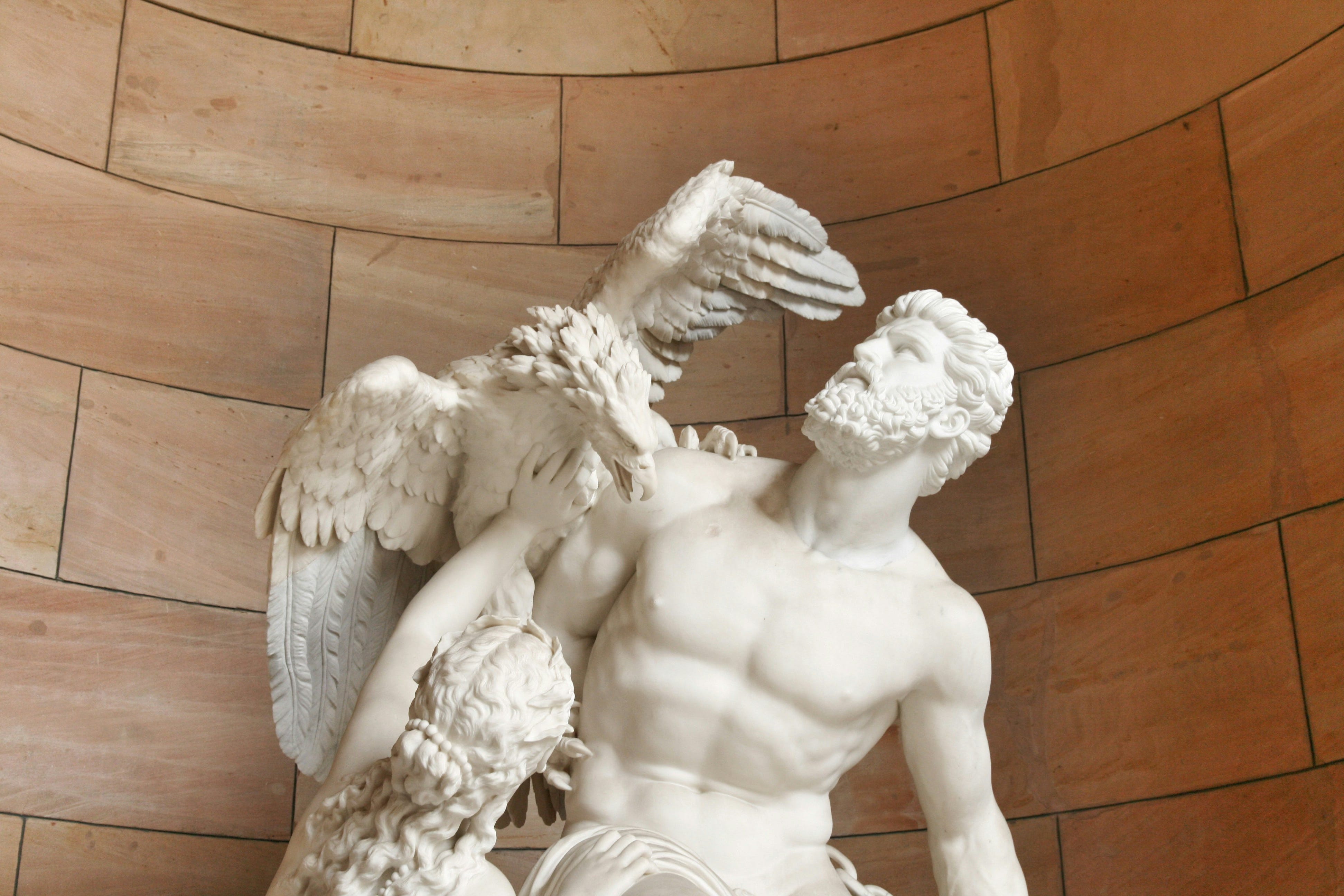
Photo by Christian Paul Stobbe on Unsplash -Prometheus and the Oceanides and eagle Ethon - Scuplture by Eduard Müller (1872/79) at Alte Nationalgalerie Berlin.
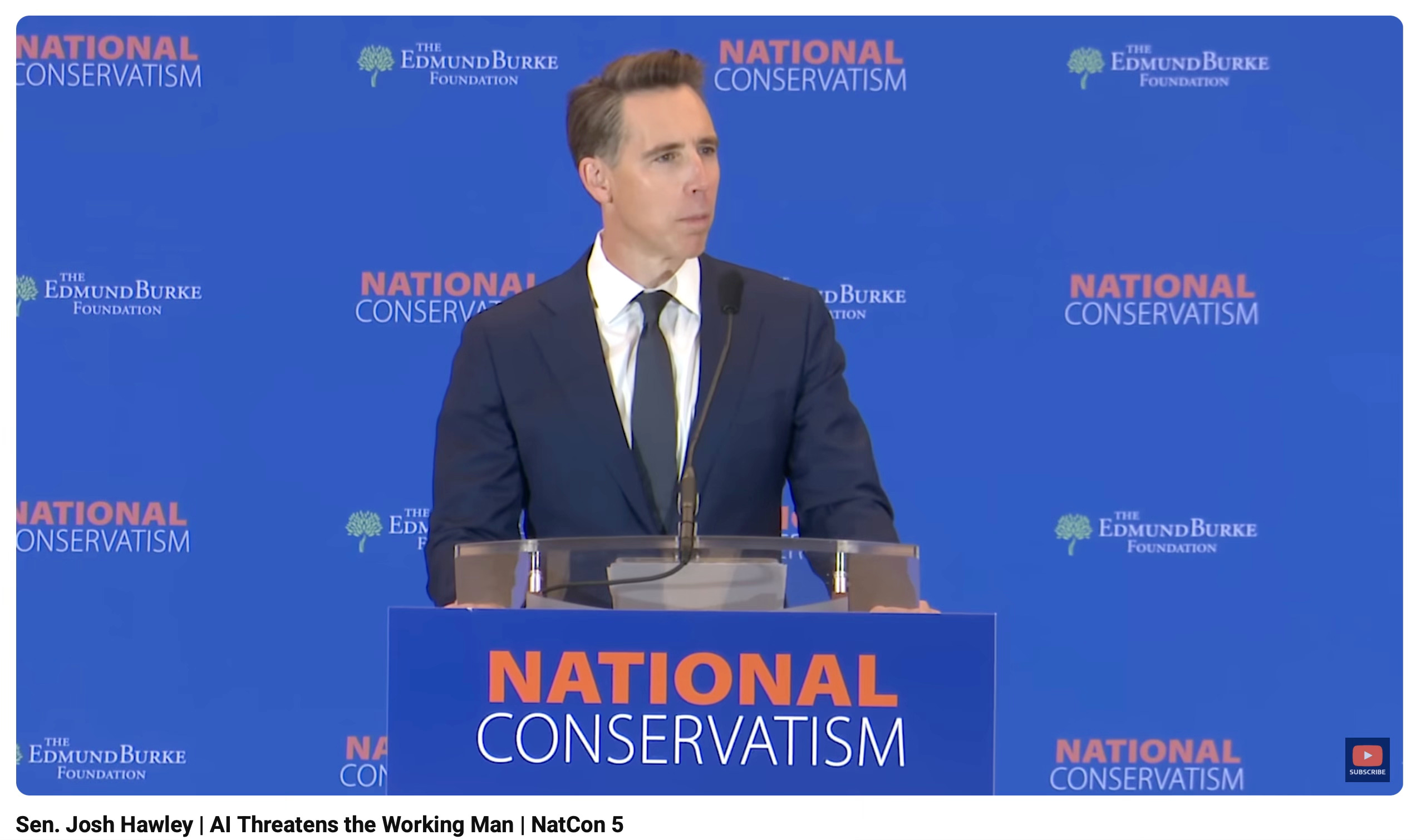
“The eugenicist Julian Huxley predicted this as far back as 1957. He wrote then that “a thousand million years of evolution” would lead to a moment when man, harnessing his “modern control of physical nature” would “transcend himself”— would achieve a new state of being.Today’s technologists believe that moment is now.For Huxley, this was a religion all its own. “I believe in transhumanism,”
he liked to say. And so do untold numbers of today’s tech class.That is the vision — the religion and ideology—that animates so much of the breathless race for artificial intelligence … and for artificial general intelligence … and super-intelligence, and beyond
: for the day when humans are no longer embodied beings at all but live infinitely in the cloud.
The technologists have discovered Gilgamesh’s plant, they believe. The question is, can America survive their quest for immortality? Can the republic?”…
— Hawley: AI Threatens the Working Man
[LINK]
“The foundation of Marx’s philosophy was a radical rejection of any form of dependence. And he thought basically that mankind as a whole was a blank slate that we could radically refashion, but we did that by refashioning society. Because his materialism and his historicism basically said, “You’re entirely a product of social forces…
…So, basically, the way you change people’s ideas and ideals and thought process is by changing the underlying material forces.Marx thought you did this economically through the communist revolution, and while his economics has been rejected, his basic metaphysical premise that human nature can be radically remade is still very current among a lot of people.And that can happen either through science and technologyor Marxist thought, or that can happen through radically remaking society, which would change the way in which people think you’re infected by bourgeois consciousness now, but after the revolution, then you’re going to be enlightened with proletarian consciousness, or whatever”…
— On the "Ersatz Religion" of Transhumanism: Interview With Dr. Aaron Kheriaty
[LINK]
“Tragedy occurs when man, through pride (or even through stupidity as in the case of Ajax)enters into conflict with the divine order, personified by a God or incarnated in Society. And the more justified his revolt and the more necessary this order, the greater the tragedy that stems from the conflict” …
– Excerpt from Albert Camus, On the Future of Tragedy
[ LINK ]
“The philosophy of Eric Voegelin offers insight into the causes of the twentieth-century nightmare, causes, he suggests, bound up with the very nature of “modernity” itself.
According to Voegelin, the great modern ideological movements—communism,fascism,national socialism— are neither random and inexplicable outbursts nor solely the products of particular material and historical conditions.They
should be understood instead as the extreme manifestations of a form of spiritual disorder or psychic disorientation that springs from certain tensions inherent in human existence.
For Voegelin,the crisis of modernityis inessence a spiritual crisis rooted in adeformation of the truth of reality”…
— Linda Raeder
[LINK] - Voegelin on Gnosticism, Modernity, and the Balance of Consciousness
Reason, Enlightenment and the emergence of Liberation Ideology and Theology
A liberation from the Transcendent (e.g. Nietzsche’s Death of God [LINK] - Marxism’s Man as God [LINK]), a liberation from the Human Condition (e.g. a Nietzschean Will to Power [LINK]), a liberation from the intolerable conditions and suffering of the material realm (e.g. Modern Gnosticism [LINK]), and a liberation from himself (e.g. Trans Humanism [LINK]).
[LINK]
Reason was a key idea of the Enlightenment (e.g. Temples of Reason [LINK], Cult of Reason [LINK] ) that equipped Man to use his own judgment and discernment to think (e.g. “Cogito, ergo sum" - Descartes), determine what was right and wrong (e.g. Marx - Legal Positivism [LINK]), and ultimately transform the Material World (e.g. Marx - Historical Materialism [LINK]) and liberate (e.g. Nietzsche) himself.
“For Hegel, freedomwas not just a psychological phenomenon but the essence of what was distinctively human. In this sense, freedom and nature are diametrically opposed. Freedom does not mean the freedom to live in nature or according to nature; rather, freedombegins only where nature ends.Human freedom emerges only when man is able to transcend his natural, animal existence and to create a new self for himself.The emblematic starting point for this process of self-creation is the struggle to the death for pure prestige”…
― Francis Fukuyama, The End of History and the Last Man
A liberation from the transcendent, including traditional moral values and religion (refer to Nietzsche);
A liberation from the Human Condition that was inherent within the Contingent Being of Man (refer to Artificial General Intelligence, Trans Humanism, Scientific Gnosticism (Scientism), Nietzschean Übermensch, Nietzschean Will to Power);
A liberation from the intolerable conditions and suffering of the Material Realm through attaining a Consciousness - a Gnosis (refer to Gnosticism, including Modern Gnosticism, Trans Humanism, Geo-Bio-Genetic-Engineering, Cartesian Mechanical Machine World View, Heidegger’s Technology Enframing (Bestand - Standing Reserve), and Jacques Ellul’s Technology Society & System); and
A liberation from an independent objective Reality (refer to the Theology of Marxism (i.e. a power-directed system of thought), Nietzsche’s Theory of Perspectivism, Saussurean Dyadic Semiotics, Jean Baudrillard’s Post-Modern Simulacra, Simulation and HyperReality ).
The material manifestation of this idea is ever-present in various Marxist Revolutions that have occurred across the World post the arrival of Modernity, including inter alia the French, Russian, and Chinese variants.
Refer - [LINK] - Implications & human cost of the French, Russian, and Chinese Revolutions
It reflected a rejection of custom, tradition, history [LINK], and authority (e.g. Church [LINK]).
It reflected a rejection of the transcendent [LINK] and the Divine [LINK].
Conscious Man was now empowered to transform the nature of Reality (e.g. Hegel’s Second Nature) through embracing the Primacy of Human Consciousness, rules of abstraction [LINK] and the application of instrumental reason [LINK].
A Revolution of the Mind [LINK], the emergence of the Individual [LINK] and human freedom - a thinking, conscious, acting being [LINK].
A Primacy of Modern Man.
The application of Scientific Instrumental Reason to Technology to create a Technological Society [LINK] and Technology System [LINK].
The pursuit of a Theory of Everything [LINK] where the human intellect had unbounded rationality — limitless explanatory power [LINK] — as we accelerated our progressive long march forward [LINK] to the Singularity [LINK] and the Omega Point [LINK].

[LINK] - AI Threatens the Working Man
[LINK] - AI Threatens the Working Man

[LINK] - An Innate Despair: The Philosophical Limitations of Transhumanism and its Misplaced Hope in Human Enhancement

[LINK] - The Promethean Impulse
[LINK] - Are Humans really software to be programmed?
[LINK] - The Philosophy of Mechanisation
[LINK] - Journal of Theoretical Biology - Is the cell really a machine?
“The death of the spirit is the price of progress. Nietzsche revealed this mystery of the Western apocalypse when he announced that God was dead and that He had been murdered. This Gnostic murder is constantly committed by the men who sacrificed God to civilisation.
The more fervently all human energies are thrown into the great enterprise of salvation through world–immanent action, the farther the human beings who engage in this enterprise move away from the life of the spirit.And since the life the spirit is the source of order in man and society, the very success of a Gnostic civilisation is the cause of its decline”…
― Eric Voegelin, The New Science of Politics: An Introduction
Footnote: