
Triadic of Logic
Study of Thought (Logic) - Aristotle, Boole and Peirce


Photo by 愚木混株 Yumu on Unsplash
“The one [the logician]studies the science of drawing conclusions, the other [the mathematician] the science which draws necessary conclusions”…
— J R Newman, The World of Mathematics
“Mathematics is purely hypothetical
: it produces nothing but conditional propositions.The pragmatist knows that doubt is an art which has to be acquired with difficulty”…
— Charles Sanders Peirce
Given that Logic is the Study of Thought, could we understand Western Civilisation’s development of logical thought through the prism of the Triadic Categories of Thought (i.e. Ontological (Aristotle), Epistemological (Kant) and Phenomenological (Peirce)) [LINK] that reflect three modes of Being (Peirce) [LINK] and a triadic of Reason (i.e. Deduction (Aristotle), Induction (Bacon), Abduction (Peirce)) [LINK]?
Recognising the Intellectual Triadic Scaffolding of Western Civilisation [LINK].
Could this understanding also reflect the Three Epoques [LINK] of Human Being’s understanding of the nature of Reality, namely:
First Epoque - Age of Being: Ancient Greece and early to mid (e.g. Scholastics) Judeo-Christianity - God’s Creation and Divine Order - Human understanding God’s Creation;
Second Epoque - Age of Knowing ( Age of Reason, Logic and Scientific Inquiry): European Enlightenment - Human Creation: Science & Technology - Human Understanding & Creation; and
Third Epoque - Age of Meaning: Conscious Man’s phenomenological relationships of the whole (Peirce) grounded in the relationship of this Being (Dasein) to Being (Sein) (Heidegger) and mediated via Signs (Peirce) & emergence of Semiotics - Human understanding the relationship between God’s Divine Order & Creation and Human Understanding & Creation that deepens our understanding of the intelligibility of the Cosmos.
The Three Epoques: Study of Thought (Logic) - Aristotle, Boole and Peirce

[LINK] - The Third Epoque
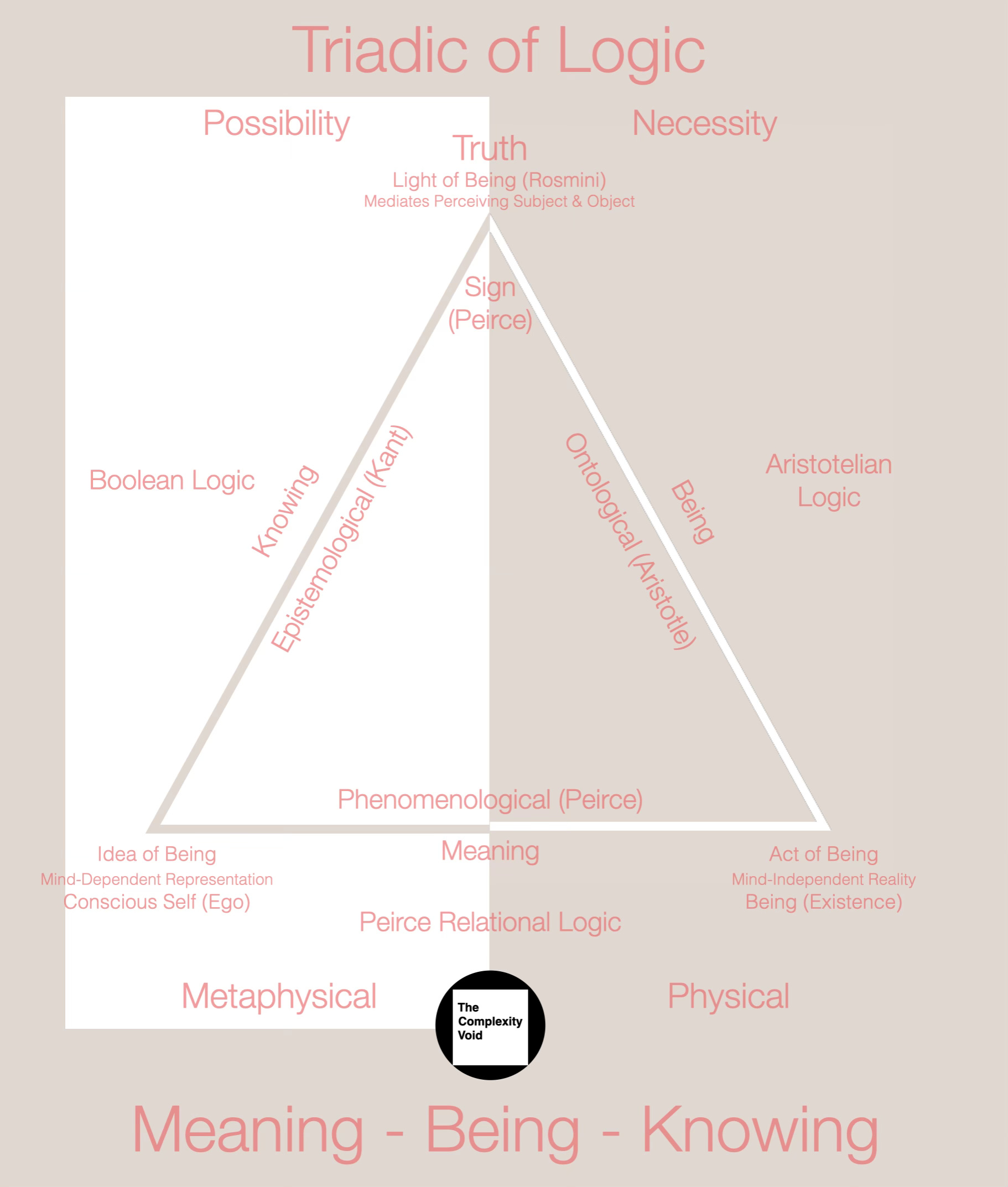
First Epoque: Age of Being - Aristotelian Logic: Ontological Syllogisms and Deductive Reasoning
“It is impossible for anyone to believe the same thingto be and not be”…
- Aristotle, Metaphysics
First Epoque: Aristotelian Logic that is grounded in Being (Existence (act of Being) - Plato - Ontological Categories - Aristotle) - Combines Ontological Syllogisms (symbolic abstractions that mediate between knowing and being) and Deductive Reasoning that, when combined, expresses the rationality of existence.
Note: The emergence of Modal Logic extends Aristotle’s logic formally, but departs from his ontological foundations. It transforms Aristotle’s metaphysical modalities—necessity and possibility as modes of Being—into formal modalities defined in terms of truth across possible worlds. Given modern modal logic abstracts modality from its original ontological grounding in Being, it is more akin to the Second Epoque Epistemological Representation outlined below in the Boolean Logic example.
Second Epoque: Age of Knowing - Boolean Logic: Epistemological Representation and Algebraic Manipulation - Emergence of Top-Down (e.g. Classical Computing) grounded in Deductive Reasoning and Bottom-Up (e.g. Machine Learning) grounded in Inductive Reasoning forms of Computation
“A successful attempt toexpress logical propositions by symbols, the laws of whose combinationsshould be founded upon the laws of the mental processes which they represent, would, so far, be a step towards a philosophical language”…
— George Boole
Second Epoque: Boolean Logic that is grounded in Transcendental Structures of Thought (a priori forms of understanding identified by Kant as the basis for Human cognition). Combines Epistemological Representation (i.e. symbolic abstractions of knowledge detached from ontological reference) with Algebraic Manipulation (operating as a syntactical system of formal rules that govern the relations among mental symbols). Boolean logic reflects a shift from an ontological logic of Being to an epistemological logic of Representation, in which thought no longer mirrors existence but formalises its own internal operations.
Examples: Classical Computing (often executed via CPUs), grounded in classical algorithms, deterministic rules-based operations embracing top-down deductive reasoning and boolean logic (i.e. computer software). Machine Learning (often executed via GPUs), grounded in statistical inference techniques of operations embracing bottom-up inductive reasoning and boolean logic (i.e. computer software).
Third Epoque: Age of Meaning - Peirce’s Triadic Semiosis (Relational Logic) and Abductive Reasoning
“I only desire to point outhow impossible it is that we should have an idea in our minds which relates to anything but conceived sensible effects of things” …
— Charles Sanders Peirce
Third Epoque: Peirce’s Relational Logic, grounded in the phenomenological modes of Being (Peirce - Firstness, Secondness, and Thirdness), integrates the triadic structure of semiosis—Sign, Object, and Interpretant—with the creative inferential process of Abduction.
[LINK] - What is the relation between Peirce’s Logic and his Philosophy of Logic?
Through this synthesis, Peirce establishes a dynamic mediation of meaning between the embodied interpretant and an objective reality—the Real that is independent of thought of the conscious self.
“ For what is it for a thing to be Real? [ — ] To say that a thing is Real is merely to say that such predicates as are true of it, or some of them, are true of it regardless of whatever any actual person or persons might think concerning that truth. Unconditionality in that single respect constitutes what we call Reality”…
— Charles Sanders Peirce
In contrast to Aristotelian logic, which articulates the rationality of existence (i.e. the ontological act of Being - noting Metaphysics is the study of Being), and Boolean logic, which formalises operations upon epistemological representations (i.e. a priori forms of understanding), Peirce’s relational and triadic frameworks reveal how conscious experience (phenomenal encounter), belief (habit of interpretation), and meaning (interpretive outcome) interact in a mediated rational logical process.
By situating logical thought within relational wholes rather than isolated propositions, Peirce demonstrates that meaning emerges as the mediating relation that brings together, through our conscious experience (phenomena), a sense of coherence [LINK] of being and knowing through the continuous living process of semiosis.
“But by “semiosis” I mean, on the contrary, an action, or influence, which is, orinvolves,a cooperation of three subjects, such as a sign, its object, and its interpretant, thistri-relative influencenot being in any way resolvable into actions between pairs”…
– Charles Sanders Peirce
The composite triadic structure of semiosis (Interpretant, Sign, Object) reflect a process of inquiry that is fallibilistic, contextual, and yet capable of synthesising the particular (singular experiences) and the universal (general laws and habits).
In this sense, Peircean logic (i.e. a relational process-oriented logic in contrast with Boolean Logic’s formality) embodies a phenomenological grounding (Firstness, Secondness, Thirdness) in a semiotic-objective understanding.
A logic that recognises that rational thought is inseparable from signs that mediate meaning, noting that semiosis is a tri-relative influence between the sign, object and interpretant.
The dynamic relational interplay of signs that arises from the infinite unfolding relational process of semiosis.
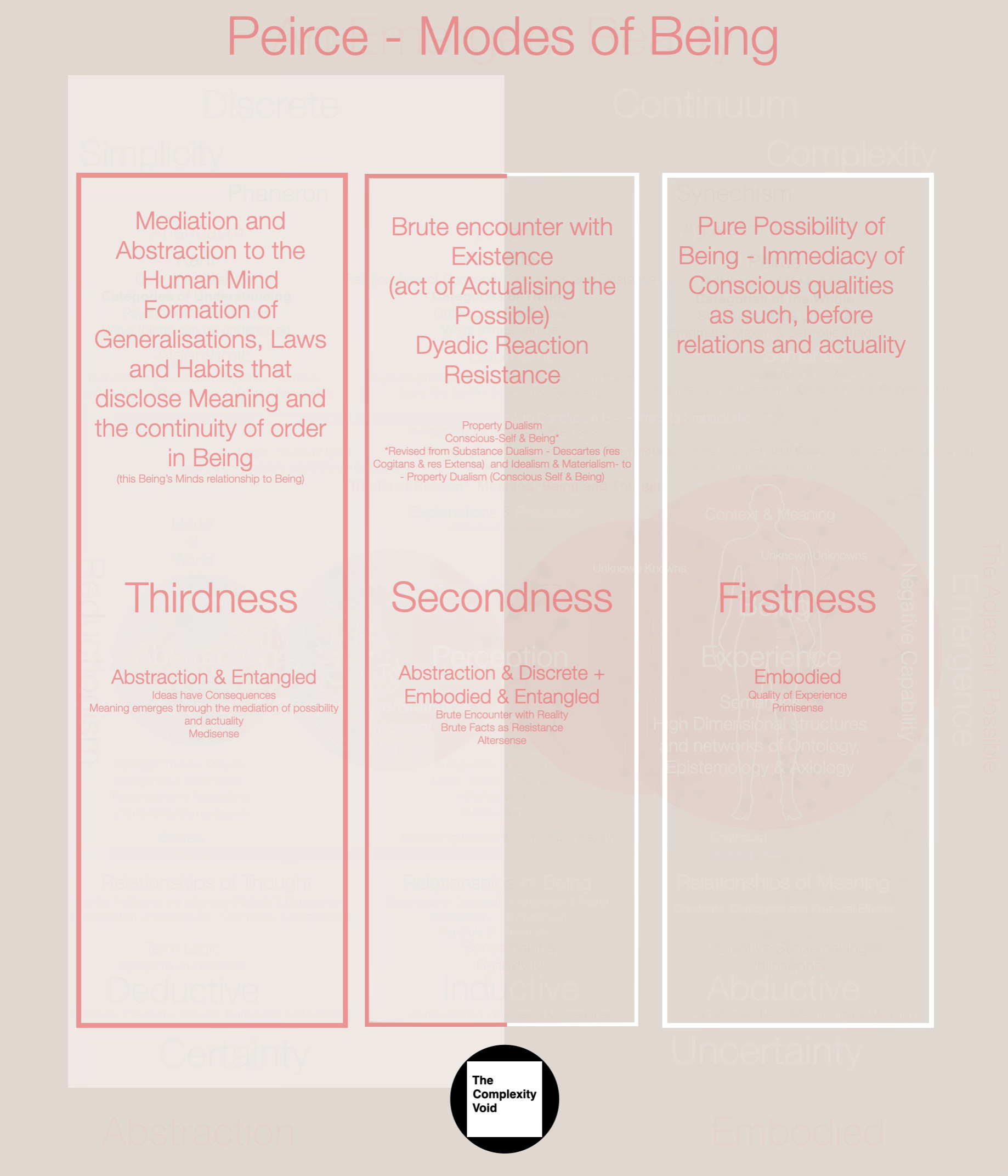
The Source of Man’s Intelligence - Semiosis, Being and God
“Abduction is the process of forming an explanatory hypothesis. It is the only logical operation which introduces a new idea: for induction does nothing but determine a value and deduction merely evolves the necessary consequences of a pure hypothesis”…
— Charles Sanders Peirce
As briefly explored in The Ghost in the Machine - Intelligence is not Computation [LINK], it is through a Human Being’s (Dasein) relationship to Being (Sein) and our embodied lived experience that new potential relationships of meaning (i.e. an explanatory hypothesis) emerge through the triadic semiosis process (Peirce), Abductive Reasoning (Peirce) and our capacity to bring a Sense of Coherence [LINK] and unity to Being.
Intelligibility of Reality is relational (Semiosis - Peirce - Dasein relationship to Sein - Heidegger - Intentional Consciousness - Husserl), logical (Peirce, Boole, Aristotle) and biological (act of Being (Plato)), grounded in the context of an entangled living being (Heidegger).
Noting that God (i.e. Necessary Being) is the ultimate source of Man’s Creation (i.e. Contingent Being) and the source of Truth - the light that illuminates the intelligibility of Being (i.e. light of Being - Rosmini - role of signs in rational thought and semiosis - Peirce).
“It is this‘idea of existence‘or‘light of being‘given to man which constitutes the objectivity of truth, as seen by the human mind.For truth is that which is, as falsehood is that which is not.It is this which makes man intelligent, andgives him a moral lawby which he sees thebeingnessoressence of things, and recognises theduty of his own being, toact toward each being, whetherfinite or infinite,creature or God, according to thebeingness or essence of beingwhich he beholds in thelight of the truth of being”…- Antonio Rosmini
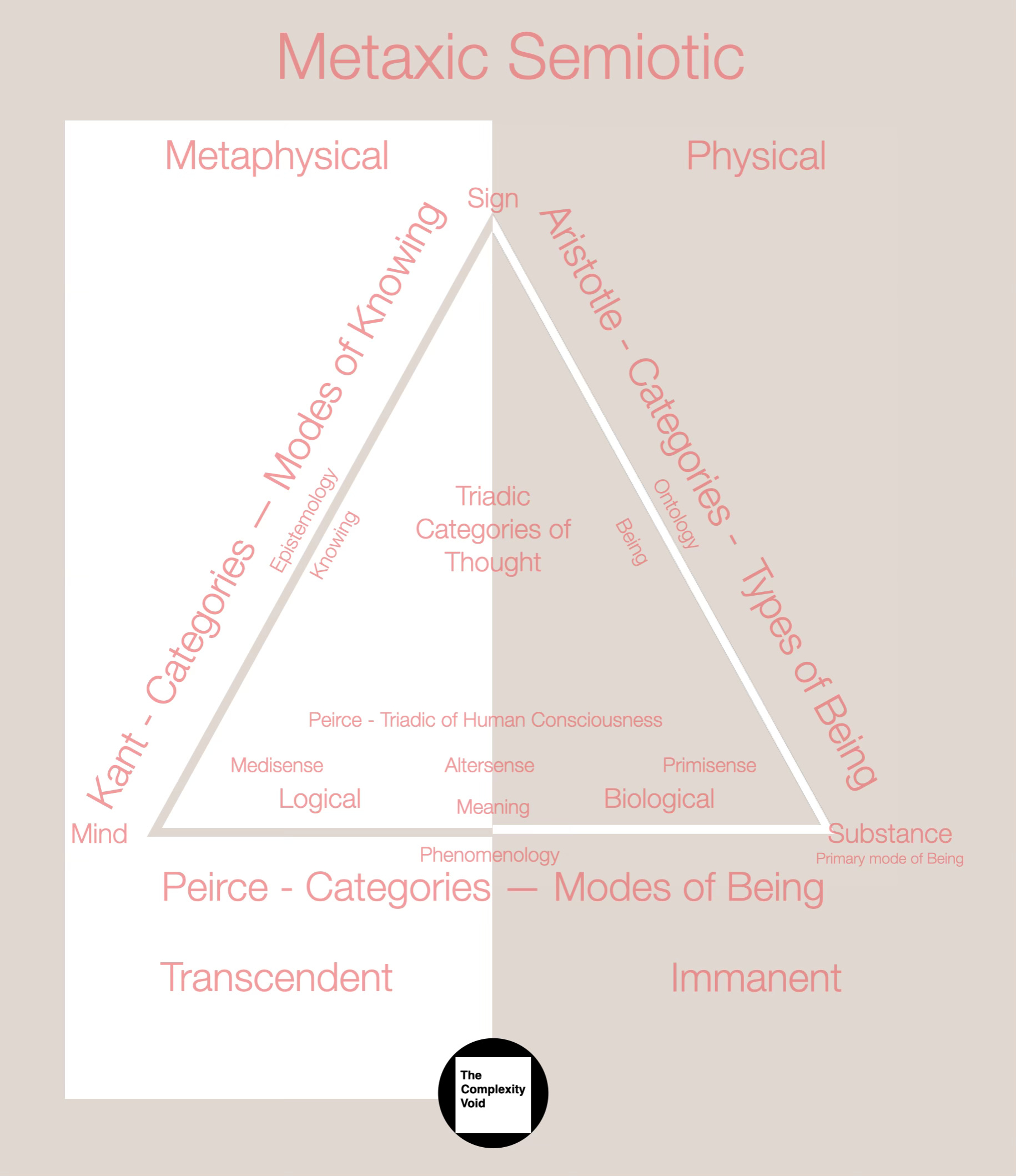

Being as the Teological Common Ground of Divine and Natural Revelation

Photo by Marcus Dall Col on Unsplash