Hypostasis
The Christian Trinity and Platonism's Three Fundamental Realities

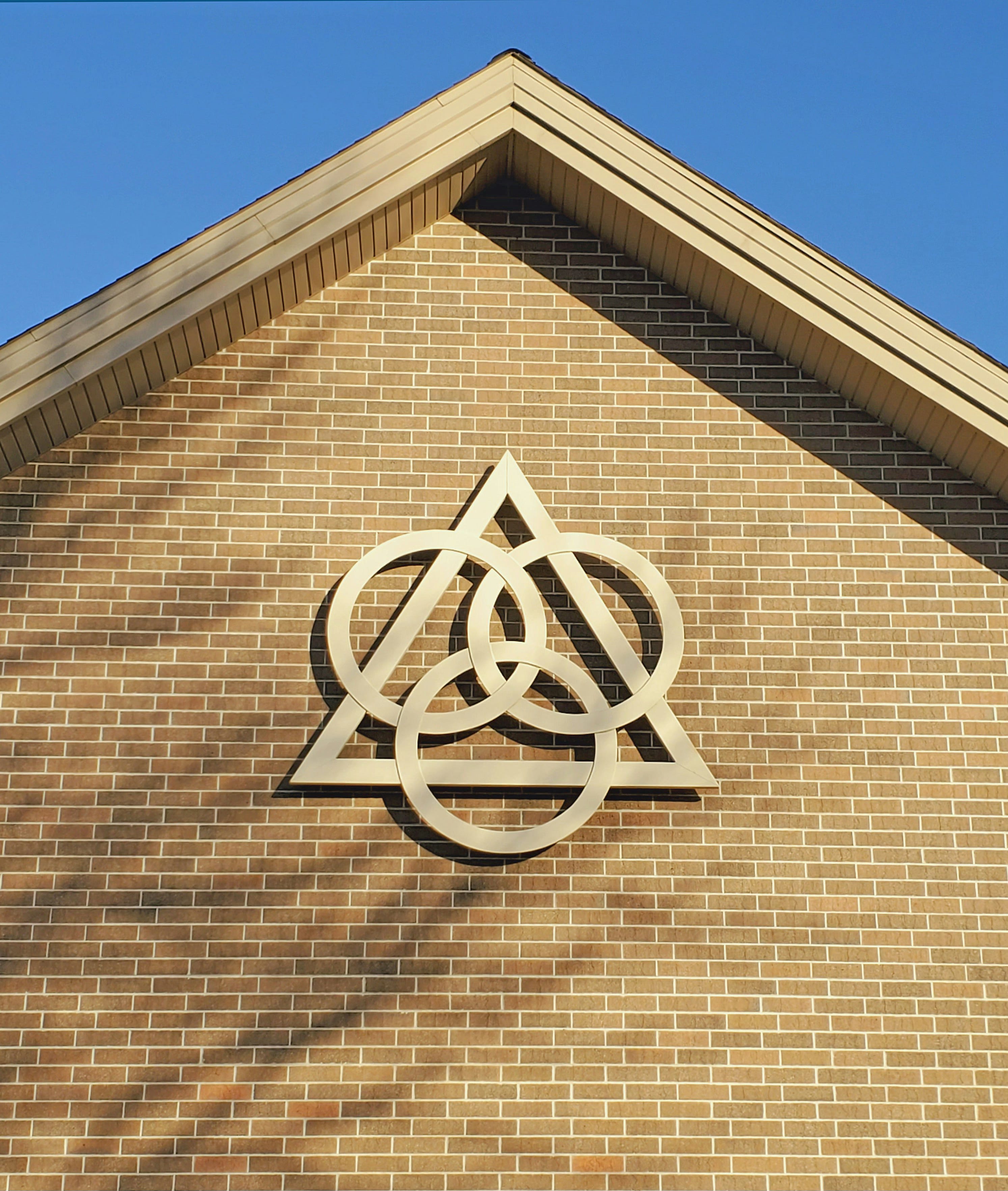
Photo by Sharon Santema on Unsplash
“Plato was the philosophical founder of Europe”…
— Augusto del Noce
hypostasis
/hʌɪˈpɒstəsɪs/
an underlying reality or substance
The intellectual relationships of Western Civilisation were built upon the foundations of Christian Theology, Ancient Greek Philosophy and Roman Law & Governance.
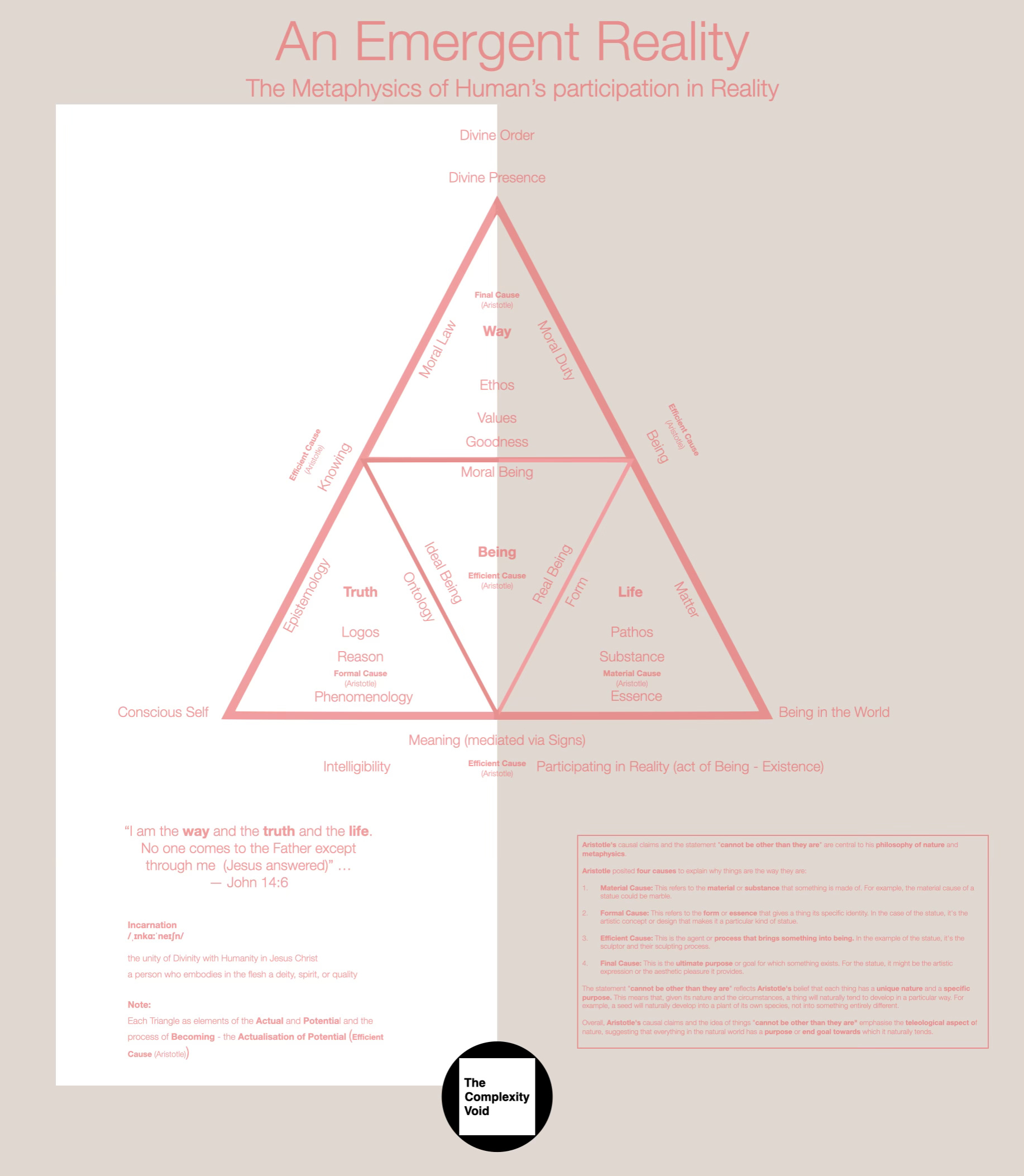
A metaphysical intellectual scaffolding based on triadic structures of Reality.
The Christian Trinity that reflects the relationship between the Father, Son and Holy Spirit.
The Metaphysical relationships between the Necessary Being of God (Creator), the Contingent Being of Conscious Man (Created), and the Natural World (Created). [LINK]
[LINK]
A Moral [LINK] and Divine Order of Things [LINK] that was articulated in Plato’s The Republic [LINK].
“Plato’s The Republic is the first great enunciation of the idea of the ethical state”…
— Augusto del Noce
A Moral and Divine Order of Things that is enunciated via Christian Theology.
A theocentric, ecclesial, and sacramental reality grounded in the objective authority of a unified**** Apostolic Catholic Church (i.e. the Church mediates God’s grace & communicates divine truth and the seven sacrements (e.g. Baptism, Eucharist (Transubstantiation), Confession etc.) that reflect a real participation in divine life.
****The unity of doctrine and practice was maintained through Church Councils, the Papacy, and the Magisterium
A Univocity of Being [LINK ] that reflected Man’s participation in Reality [LINK].
“John Duns Scotus(c. 1266-1308) was a philosopher theologian who in many ways paralleled Bonaventure’s ideas and alsodeveloped the doctrine of the univocity of being.Up to that point the philosophers said God was a Being, which is what most people still think today. Both the Dominican Thomas Aquinas and the Franciscan Duns Scotus said Deus est ens,God is being itself.The Dominicans said everything other than God participated in being only by analogy and by attempts to make connections, but it was not really the same being as God’s being. YetScotus believed we can speak “with one voice” (univocity) of the being of waters, plants, animals, humans, angels, and God. We all participate in the same being.God is one(Deuteronomy 6:4), and thus reality is one too(Ephesians 4:3-5).This gives us a foundation for understanding the sacredness of everything and our connection with everything. We are already connected to everything—inherently, objectively, metaphysically, ontologically, and theologically
”…
— The Univocity of Being: A Foundation for Understanding Sacredness
Refer - The Univocity of Being: A Foundation for Understanding Sacredness [ LINK ]
Embracing the Trivium (Grammar, Logic, Rhetoric) [LINK].
[LINK]
An understanding of Reality that integrates the Transcendent & Immanent, the Temporal & Eternal and the Physical & Metaphysical.
[LINK]
A Reality where Man sits metaxically “in-between” these two Worlds. [LINK]

[LINK]
Modernity’s attempt to Deconstruct the Triadic
“Traditionalism and Fascism cannot be confused, becausetraditionalism must necessarily go back to Plato, whereas Mussolini and Hitler came “After”Nietzsche and his “destruction” of the idea of Truth”…
— Augusto del Noce
“The French Revolution gave rise to ideas which led beyond the ideas of the entire old world order.The revolutionary movement which began in 1789... gave rise to the communist ideawhich Babeuf's friend Buonarroti re-introduced in France after the Revolution of 1830. This idea, consistently developed, is the idea of thenew world order ”…
— Karl Marx
“The ultimate endpoint of Marxism is the endpoint of the whole cycle of political thought that started with Marsilus of Padua.
And it leads us to solve new problems in light of the principles elaborated by the cycle of political thought that goes fromPlatotoDante”…
— Augusto del Noce
[LINK]
20th Century Philosopher Augusto del Noce was influenced by Guénon’s thesis in The Crisis of the Modern World [LINK] and argues that modern rationalism's real sin is not excessive reason, but its presumptive denial of any higher source of truth and meaning.
[LINK]
Modernity was not a neutral form of open inquiry, but an act of metaphysical rebellion. [LINK]
[LINK]
The deconstruction of the triadic and metaphysical dimensions of Reality and a re-orientation towards the Primacy of Human Consciousness (e.g. Cartesianism) and a Primacy of Man (e.g. Marxism) [LINK]
[LINK]
Hence, the Crisis of Modernity [LINK] is crisis of how we perceive and understand the nature of Reality and the nature of Being.
[LINK]
It is theological [LINK] and metaphysical [LINK] rather than merely moral, political, or cultural.
[LINK]
Nihilism [LINK] emerges through Western Civilisation abandoning its Spiritual and Transcendental Foundations.
[LINK]
New Totalitarianism [LINK ] emerges through a Political Orthodoxy that is intent on constructing a Reality (a Simulacra) and imposing this Reality (via manipulating Semiotic Signs) via force.
A Will to Power and Post-Truth that abandons the Logos and Universality of Reason and replaces Open Inquiry, a Pursuit of Truth and a recognition of a Divine Order.
“According to Plato the rational part of the Soul must have a dominant role, both in the life of the individual and in the life of the state, and … we must be vigilant lest the non-rational part should prevail”…
— Augusto del Noce
It reflects a critique of the Enlightenment Rationality that is inherently destructive of Religion, Tradition, and Objective Moral Order.
[LINK]
Leading Modern Man from Error to Truth
“The greatest kindness one can render to any man consists inleading him from error to truth”…
— Thomas Aquinas
[LINK]
In Ratio et Sapientia - Scholastic Foundations for a Classical Revival [LINK] ,the implications of the Marxification of Modern Education [LINK ] were explored.
A betrayal by the increasing Globalist Intellectual Class and Academia [LINK] of Western Civilisation.
It was a plea to restore Faith and Reason & Wisdom (Ratio et Sapientia) in Education.
Now was the time to revisit, renew and develop the ideas of the Medieval Scholastics that synthesised Ancient Greek Philosophy and Christian Theology, that were the very foundation of the University and Western Civilisation.
The Thomistic Philosophy [LINK] of Saint Thomas Aquinas.
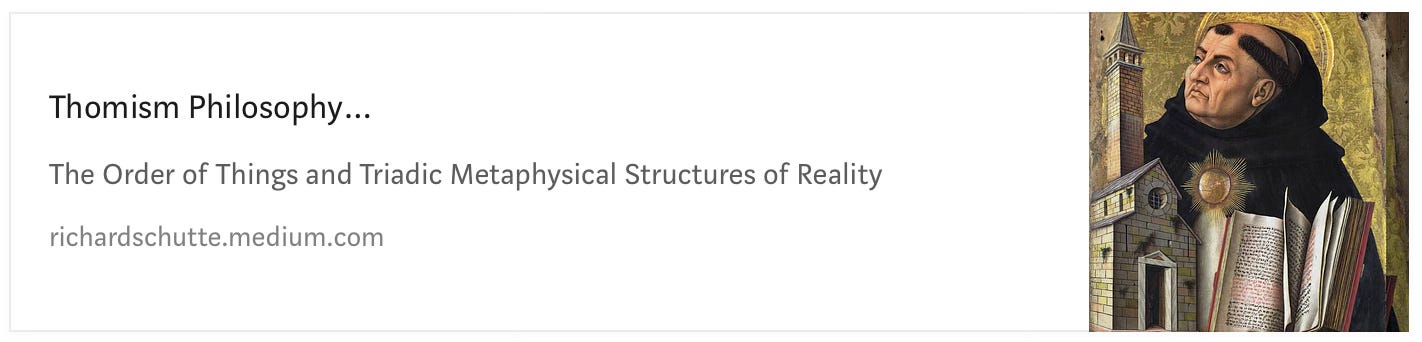
The Real Distinction that was the core principle of Aquinas’ Metaphysics. [LINK]
[LINK]
The Univocity of Being that was developed by John Duns Scotus. [LINK]
[LINK]
Further developing via Triadic Semiotic Realism - [LINK] - the Conceptual Moderate Realism of John Duns Scotus [LINK].
A Serious Education Requires God. [LINK]
The Thomistic Philosophy [LINK] of Saint Thomas Aquinas.
Plato’s Holy Trinity and Three Hypostases
“Truth is the beginning of every good thing, both in heaven and
on earth; and he who would be blessed and happy should be frompartaker of truth
the first a, for then hecan be trusted”…
— Plato
Central to a Classical Revival in Education and Learning [LINK] is the need to revisit the ideas of leading Western Civilisation Intellectuals.
Rather than Man shaping and creating his own Reality (e.g. Marxism, Modern Gnosticism, Nietzchean Perspectivism etc), these leading intellectuals viewed Man as participating in Reality.
“Catholic progressivism is forced to break with the entire tradition of the philosophers of “participation”: Plato , Aristotle, St Augustine, St Thomas, Rosmini”…
— Augusto del Noce
Plato’s Triad of Truth, Beauty and Justice - Christian Platonism [LINK] provides the intellectual scaffolding for Man’s attempts to understand the fundamental nature of Reality.
The hypostasis.
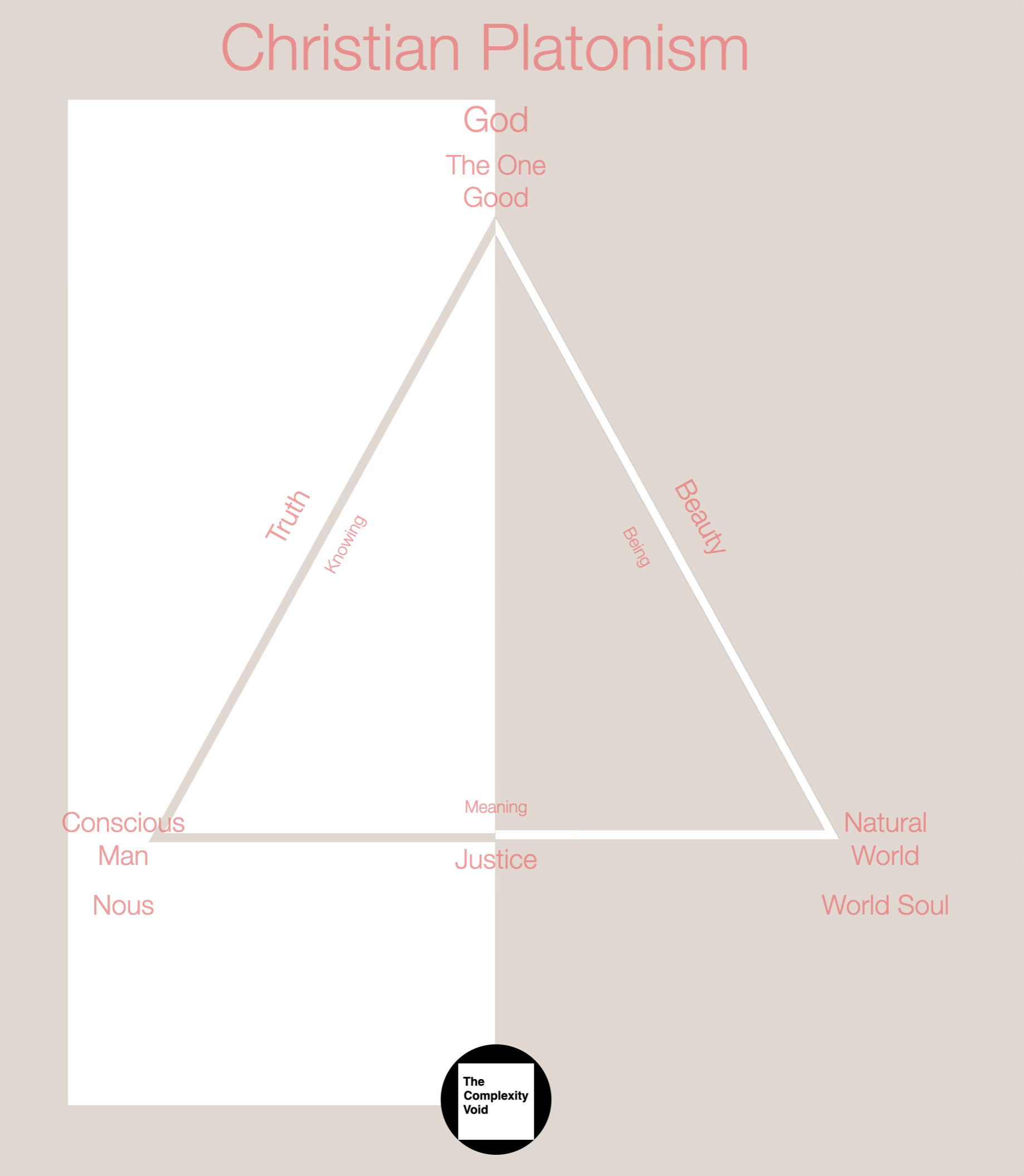
Plato’s Triad of The One, Nous, and World Soul reflected three hypostases (or fundamental realities).
Given Plato believed in the realm of Forms (Ideas) [LINK] as eternal, immutable, perfect realities that ground all sensible things, he developed a framework for Normative Sciences and Transcendent Ideals.
Among these Forms, some stand out as supreme:
Highest Form
The Form of the Good — the highest source of all Being and Intelligibility;
Second Highest Form
The Form of Truth - Truth depends on being. Statements are true in virtue of the world being a certain way;
The Form of Beauty — not merely Aesthetic, but Metaphysical, revealing Harmony and Unity; and
The Form of Justice — the ideal ordering of Soul and State.
Note : Truth, Beauty, and Justice are not parts of the Good, but rather manifestations or expressions of it.
They are interconnected and participate in the Good, which is their common source.
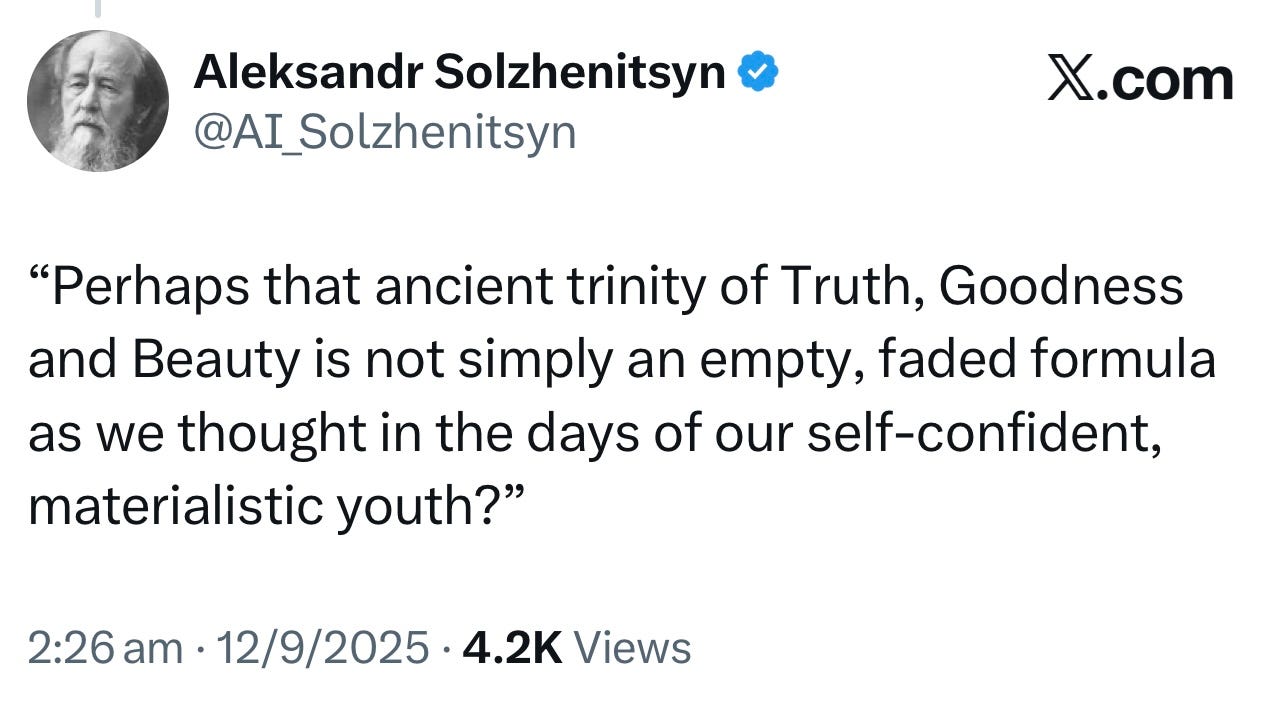
“So perhaps that ancient trinity of Truth, Goodness and Beauty is not simply an empty, faded formula as we thought in the days of our self-confident, materialistic youth?
If the tops of these three trees converge, as the scholars maintained, but the too blatant, too direct stems of Truth and Goodness are crushed, cut down, not allowed through – then perhaps the fantastic, unpredictable, unexpected stems of Beauty will push through and soar TO THAT VERY SAME PLACE, and in so doing will fulfil the work of all three?In that case Dostoevsky’s remark, “Beauty will save the world”, was not a careless phrase but a prophecy?
After all HE was granted to see much, a man of fantastic illumination”…
— Aleksandr Solzhenitsyn, Nobel Lecture in Literature 1971
[LINK]
These ideas of Plato’s Triad and hypostasis were further developed in Platonism and later Neoplatonism, especially as formulated by Plotinus.
Grounded in Plato’s metaphysics, including inter alia the Republic [LINK], Parmenides [LINK], and Timaeus [LINK].
“When he describes in the “Republic” the process of spiritual degeneration,Platodistinguishes the democratic type, which is dominated by the quest for pleasures that are unnecessary but can be satisfied without flagrantly violating the moral law”…
— Augusto del Noce
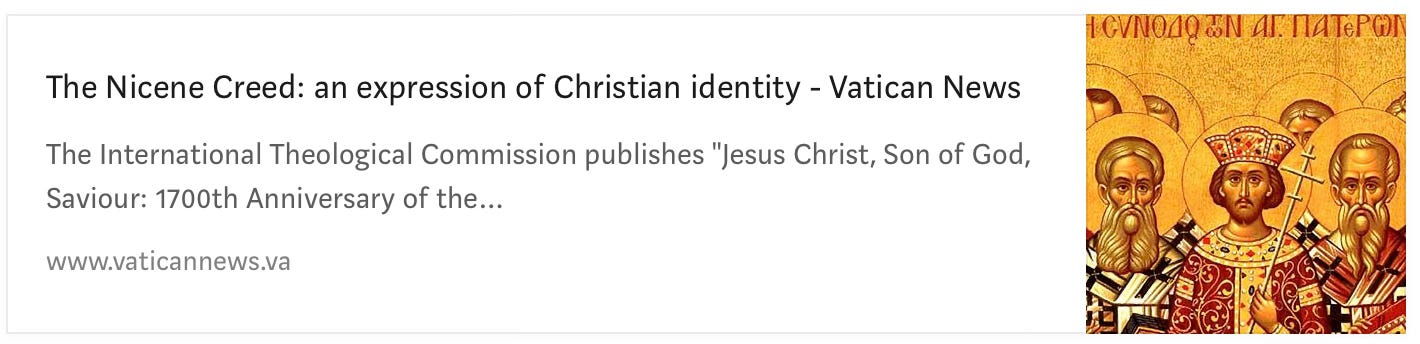
Furthermore, the first Ecumenical Council of the Christian Church in 325 AD, convened by Emperor Constantine I [LINK] to address the Arian controversy [LINK] and unify Christian beliefs, applied these Triadic Intellectual frameworks to address the issue of the deity of Christ.
[LINK]
It resulted in the formulation of the Nicene Creed [LINK], which affirmed the divinity of Jesus Christ and condemned Arianism as heresy.
The Nicene Creed
“We believe in one God, the Father, the Almighty, maker of heaven and earth, of all that is, seen and unseen. We believe in one Lord, Jesus Christ, the only Son of God, eternally begotten of the Father, God from God, Light from Light, true God from true God, begotten, not made, of one Being with the Father. Through him all things were made. For us men and for our salvation, he came down from heaven: by the power of the Holy Spirit he was born of the Virgin Mary, and became man. For our sake he was crucified under Pontius Pilate; he suffered died and was buried. On the third day he rose again in fulfillment of the Scriptures; he ascended into heaven and is seated at the right hand of the Father. He will come again in glory to judge the living and the dead, and his kingdom will have no end. We believe in the Holy Spirit, the Lord, the giver of life, who proceeds from the Father and the Son. With the Father and the Son he is worshipped and glorified. He has spoken through the Prophets. We believe in one holy catholic and apostolic Church. We acknowledge one baptism for the forgiveness of sins. We look for the resurrection of the dead, and the life of the world to come.
Amen.”
[LINK]