
Corporatism
Merger of Corporations and the State


Photo by Sean Pollock on Unsplash
““Fascism
should more appropriately be calledCorporatismbecause it isa merger of state and corporate power”…
— Benito Mussolini
[LINK]
As outlined in Three Waves - Strauss’s Critique of Modernity [LINK] American 20th Century Political Philosopher Leo Strauss [LINK] published an essay in the 1960s titled 3 Waves of Modernity [LINK].
It was a critique of modernity and the philosophical axioms that underpin its various political manifestations.
A crisis of modernity [LINK] that was primarily a crisis of modern political philosophy.
“Thecrisis of modernityreveals itself in the fact, or consists in the fact, thatmodern western man no longer knows what he wants—thathe no longer believes that he can know what is good and bad, what is right and wrong.
Until a few generations ago, it was generally taken for granted that man can know what is right and wrong, what is the just or the good or the best order of society—in a word that political philosophy is possible and necessary.
In our time this faith has lost its power.
According to the predominant view, political philosophy is impossible: it was a dream, perhaps a noble dream, but at any rate a dream.
While there is broad agreement on this point, opinions differ as to why political philosophy was based on a fundamental error.According to a very widespread view, all knowledge which deserves the name is scientific knowledge; but scientific knowledge cannot validate value judgments
;it is limited to factual judgments; yet political philosophy presupposes that value judgments can be rationally validated.According to a less widespread but more sophisticated view, the predominant separation of facts from values is not tenable
:the categories of theoretical understanding imply, somehow, principles of evaluation; but those principles of evaluation together with the categories of understanding are historically variable; they change from epoch to epoch; hence it is impossible to answer the question of right and wrong or of the best social order in a universally valid manner, in a manner valid for all historical epochs, as political philosophy requires.The crisis of modernity is then primarily the crisis of modern political philosophy”…
— Leo Strauss
Specifically, Leo Strauss [LINK] identifies the third wave [LINK] of Modern Political Philosophy as Fascism [LINK].

[LINK] - Three Waves - Strauss’s Critique of Modernity
Early to mid 20th Century Italian Communist and Socialist politician Benito Mussolini defined Fascism [LINK] as the merger of State and Corporate Power.

[LINK] - A Genealogy of Corporatism
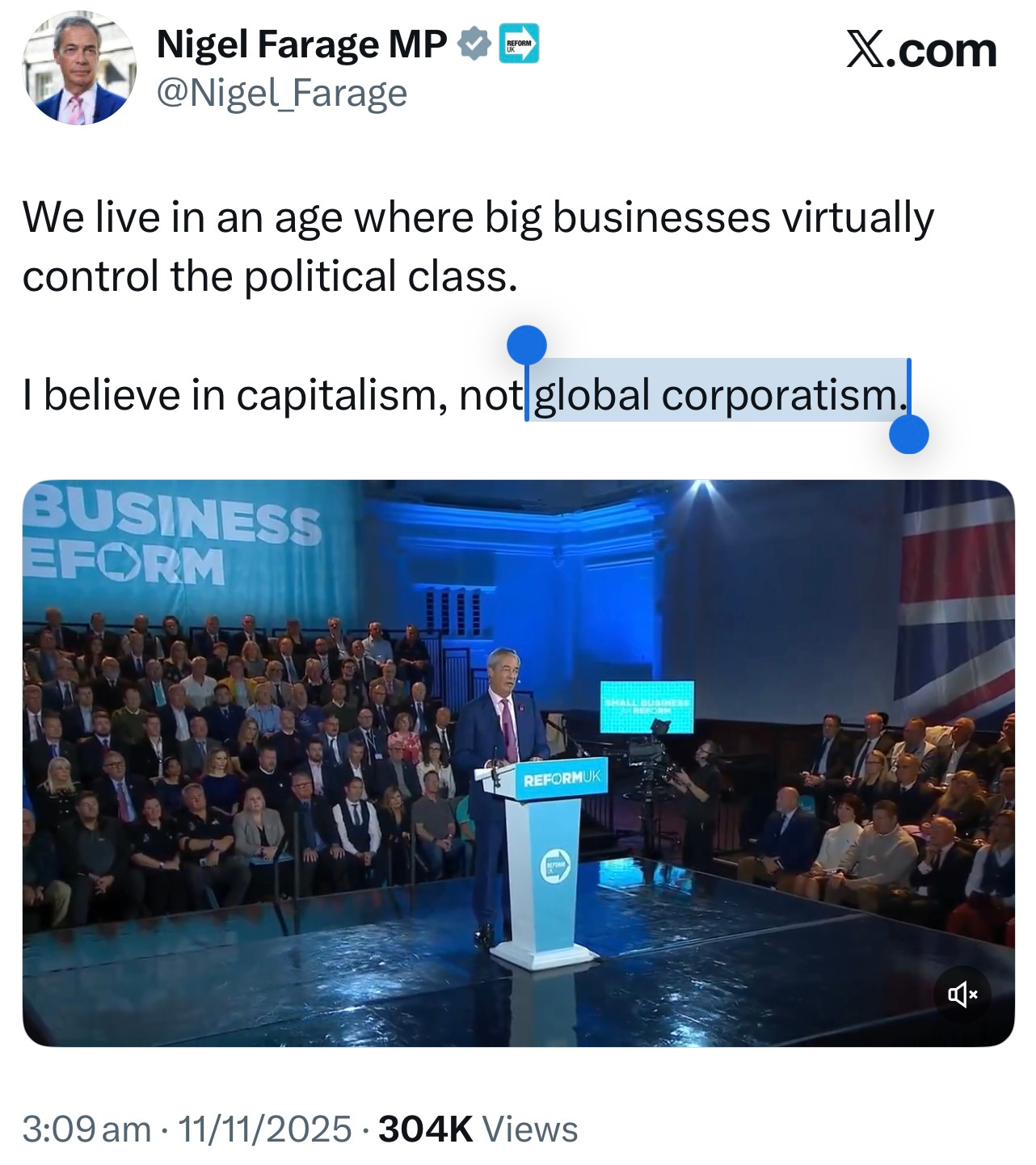
Should it be a surprise that in the first few decades of the 21st Century we are seeing an increasing merger of State and Corporate Power - also know as Corporatism (or Fascism [LINK]) ?

Is the Market-State [LINK] and State Capitalism [LINK] simply contemporary semantic variations of the same?
Is it symptomatic of a far deeper metaphysical malaise [LINK] as the Intellectual Triadic Structures of Western Civilisation [LINK] continue to be deconstructed [LINK] [LINK]?